Part two of a three-part Larym AI Intelligence™ series on brands in the age of AI.
From Being Listed to Being Understood
When Larym opened in 2006, getting a client found online could still involve filling out forms.
You submitted a website to the Yahoo Directory, paid the review fee and waited for an editor to decide where it belonged. You submitted it to DMOZ and hoped a volunteer would eventually get to it.
At the same time, something very different was taking over. Google’s crawlers didn’t wait for anyone to submit a form. They discovered pages, followed links, indexed information and helped search systems decide which pages were relevant to a query.
Our work changed with them. It was no longer enough to put a company in the right category. We had to build websites that search engines could discover, interpret and trust enough to show in their results.
Both directories are gone now. But I believe we are living through another transition that is just as significant.
AI-powered search and assistants don’t simply give people a list of links. Increasingly, they retrieve information, synthesize what they find and answer the question themselves. That changes the role of your digital presence.
You are no longer preparing your brand only to be found.
You are preparing it to be interpreted.
How Do AI Systems Understand a Brand?
There isn’t one universal process called “how AI understands your brand,” and that distinction matters.
Different AI platforms use different models, search technologies, indexes, retrieval systems, data sources and methods for generating answers. Some answers rely heavily on current web search. Others combine retrieved information with what the model already holds. What a system can access also depends on the product, the question and the information available at that moment.
But from the perspective of the organization being interpreted, one practical principle holds:
AI can only work from the information available to it.
That may include your website, search results, business profiles, structured information, articles, directories, reviews, third-party mentions and other public sources. Those sources do not always tell the same story.
A current website may describe the company one way while an old directory preserves a previous address. A founder’s LinkedIn profile may use an earlier title. A partner page may describe a service you no longer offer. An article written five years ago may reflect a version of the organization that has since evolved.
People can often recognize those differences as history. Machines may not know which version represents the organization today. That is where consistency becomes more than a brand-management issue. It becomes part of how your organization can be interpreted at all.
Three Eras of Being Found
I think about the evolution this way.
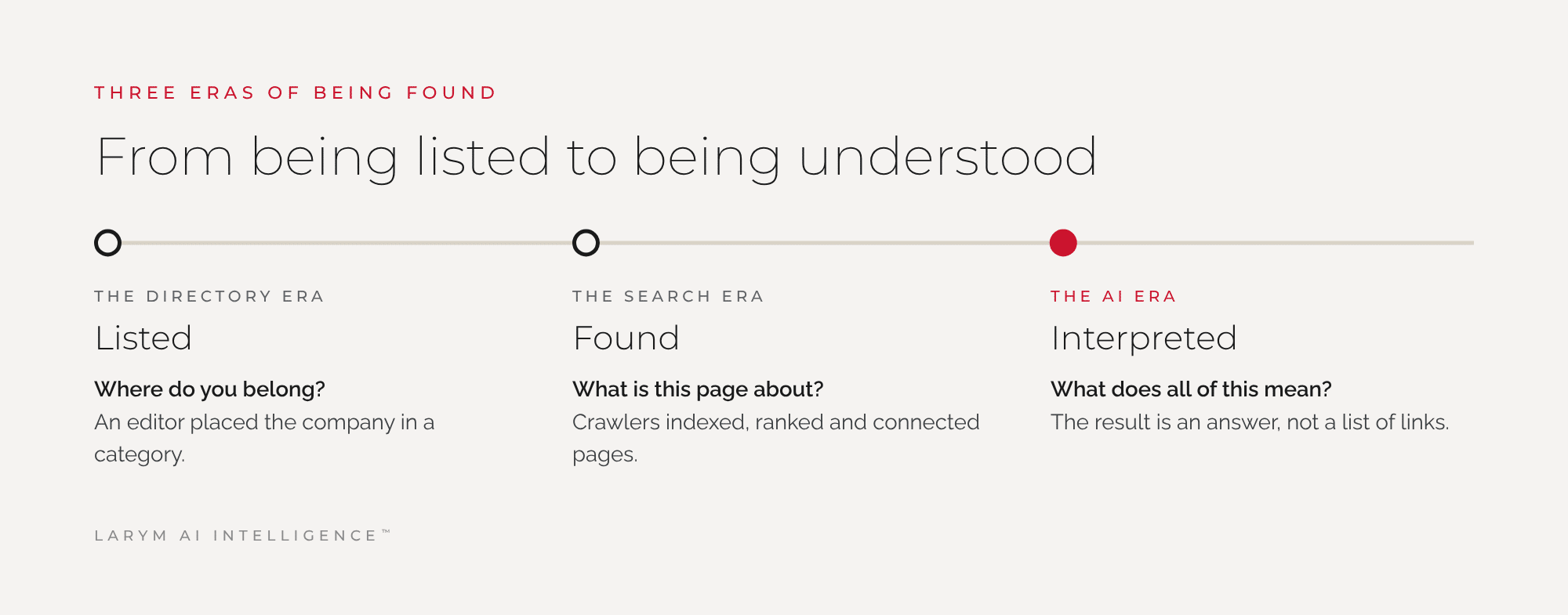
The directory era asked: Where do you belong?
A human editor placed the company in a category.
The search era asked: What is this page about, and should it rank?
Search systems crawled, indexed, ranked and connected information across the web.
The AI era increasingly asks: What does all of this mean?
The result may not be a category or even a list of links. It may be an answer, a comparison, a summary or a recommendation.
That is an important shift. Directories organized information. Search engines helped people find information. AI-powered discovery increasingly interprets information before a person ever reaches your website.
And you control only part of what it may find.
What AI May Encounter About Your Brand
There is no single checklist that every AI system reads the same way. But several categories of information shape the digital record surrounding a brand, and they are worth your attention.
What You Publish
Your website. How you describe the organization, its services, its people, its work and its point of view.
Structured information. Search systems can use structured data to understand explicit facts about an organization, including its name, location, logo and other identifying details.
Your profiles. LinkedIn, Google Business Profile, social accounts, leadership profiles and other places where the organization represents itself.
Your visual information. Logos, images, captions, alt text and the content around them, which help systems and people understand what an image represents.
What Others Publish About You
Directories and listings. The old directories disappeared, but directories themselves never really went away. Today’s listings are part of the wider information environment around an organization.
Press and mentions. Articles, interviews, partner websites, event pages, award listings and other independent references.
Reviews and client voices. What customers, partners and others say about the organization in their own words.
None of these sources exists in isolation anymore. Together, they create a digital record. When different parts of that record contradict one another, deciding what is current becomes harder for people and machines alike.
From Retrieval to Interpretation
This is where the transition becomes especially important for leaders.
Traditional search largely asked the user to do the interpreting. You searched, received links, opened several pages, compared them and decided what you believed.
AI increasingly moves that interpretation upstream. A person can now ask who the best firms are for a certain kind of work, what a company specializes in, who founded it, whether it is a good fit, or how it differs from its competitors. Instead of a list of links, they may receive a synthesized answer.
That answer can feel authoritative because it is fluent. But fluency and accuracy are not the same thing. The system may be working from incomplete, outdated, contradictory or differently weighted information.
That is why I don’t think about AI visibility simply as “ranking in AI.” The deeper issue is representation.
When an AI system answers a question about your organization, what version of you has it assembled?
That is the question leaders should be asking.
What Weakens the Digital Record
Most of the problems are remarkably ordinary:
- Different company names or descriptions across platforms
- Old addresses and former services still listed on third-party sites
- Leadership bios that don’t agree with each other
- Outdated logos and pages that describe the same service differently
- Incomplete or incorrect structured data
- Profiles that haven’t been touched in years
None of this began with AI. Most organizations accumulate some version of it simply by operating. Companies change, people change roles, services evolve, websites are redesigned and partners copy descriptions they never update. Old information stays online because nobody has a compelling reason to go looking for it.
Until suddenly there is one.
AI did not create the fragmented digital record. It changed what can be done with it. Information that once sat quietly on an old page can now become part of an answer generated for someone who has never heard of you. That makes maintenance more consequential than it used to be.
How to Influence How AI Understands You
You cannot dictate what every AI system will say about your organization. You can become much more deliberate about the information available for systems to find and interpret.
1.Ask what AI says about you now
Ask several major AI assistants about your organization, founders, services, history and expertise. Look beyond obvious errors for omissions, outdated descriptions, strange emphasis, uncertainty and differences between platforms. The goal is not to grade the AI. It is to see the version of your organization that currently emerges. Our guide to tracking brand mentions in AI search shows how to make this a habit.
2.Establish an authoritative source of truth
Decide what the current facts are: company name, short description, founding information, leadership names and titles, service names, locations and core positioning. This sounds basic. It often isn’t.
3.Align the properties you control
Start with your own website and profiles. Make sure the information you publish agrees with itself before trying to correct the rest of the internet, including leadership bios, service descriptions, business profiles, structured data and social accounts.
4.Examine the wider digital record
Then look outward: directories, partner websites, review platforms, event pages, press references, professional profiles and industry listings. You will not control all of them, but you need to know what they say.
5.Build independent evidence
An organization describing itself consistently is important. Other credible sources recognizing the same expertise adds another dimension, and it is how entity authority is earned. The goal is not to manufacture mentions for machines. It is to make sure the work you genuinely do leaves evidence behind.
6.Treat this as maintenance, not a campaign
The digital record will keep changing because the organization will keep changing, and so will AI systems. Check periodically, document what changed, correct what you can and watch what persists. The goal is not permanent control. It is responsible stewardship of the information surrounding the organization.
Larym’s Perspective
This subject is personal for us because we have lived through all three eras. We remember directory submissions. We built websites for search crawlers. We watched SEO grow from a largely technical practice into a discipline that intersects with content, brand, experience, authority and trust. Now we are adapting again.
And we are not doing it as an organization that kept every piece of its own digital history perfectly synchronized for twenty years. We didn’t.
Like many firms focused on client work, we have accumulated old descriptions, earlier versions of services, profiles created at different moments and outside references that don’t all reflect who Larym is today. We are addressing those things now, with the same scrutiny we recommend to clients.
That experience has reinforced something I believe strongly: you cannot treat AI visibility as a layer you add on top of a fragmented organization. The work begins further down. In the LARYM Framework™, it begins with Locate the Leverage: understanding how the organization is currently represented across search, AI, its own properties and the wider digital record, before deciding what to change.
Larym AI Intelligence™ extends that work into AI visibility, governance and the decisions organizations now face as AI becomes part of how brands are discovered and interpreted.
The technology is new. The responsibility to know what your organization means is not.
What This Means for Leaders
In the directory era, getting listed could be a task. In the search era, visibility became a discipline. In the AI era, representation becomes a leadership issue.
Not because leaders need to understand every model, crawler or algorithm. They don’t. They need to understand the consequence.
Someone can now ask a machine who you are and receive an answer before anyone from your organization has the chance to speak. That answer may be excellent. It may be incomplete, outdated, or a combination of pieces of your history you no longer recognize.
You cannot control every answer. But leaving the underlying information unattended is also a decision.
The organizations that manage this well will not be the ones trying to manipulate every AI response. They will be the ones making it easier for people and machines to find an accurate, current, well-supported version of who they actually are.
This series began with What Is an AI-Ready Brand? and continues with What Should You Automate, and What Should Stay Human?
Frequently Asked Questions About How AI Understands Brands
How does AI decide what to say about my company?
There is no single process used by every AI system. Depending on the platform and question, it may draw on its model, current web search, retrieved sources or a combination, which is why consistent public information matters.
Why does AI describe my company incorrectly?
Common reasons include outdated or conflicting public information, missing information, limits in the sources the system retrieved and limits in the AI system itself.
Is AI visibility the same as SEO?
No, but they are closely connected. Strong technical SEO and useful content remain the foundation, while AI visibility also considers how your information is retrieved, synthesized and represented in generated answers.
What is answer engine optimization (AEO)?
AEO is the practice of making useful information easier for answer engines and AI-powered search to discover, interpret and use in their answers. It builds on established SEO practices rather than replacing them.
Do directory listings still matter?
They can. Listings and business profiles remain part of the public record around an organization, and outdated information is worth correcting wherever practical.
How does Larym improve how AI describes our company?
We examine what major AI systems and search experiences currently say, trace inaccuracies back to their sources, then strengthen your source of truth, owned properties, technical signals and wider digital presence.
How long does it take for AI descriptions to change?
There is no universal timetable. Different systems discover, index and refresh information differently, so we monitor changes over time rather than promising a fixed window.
Can Larym help with structured data and technical SEO?
Yes. Larym implements structured data and technical SEO as part of our SEO, AEO and digital visibility work.
Does our visual identity affect AI visibility?
Visual information can contribute to how brands are recognized across search and AI experiences, though its role varies by system. Consistent logos, useful image context and descriptive alt text are good practice regardless.
Where should we start?
Ask several AI systems what they believe to be true about your organization. The differences between those answers tell you where to investigate next.
Related
- AI Visibility
- Entity Authority
- How Can a Brand Improve Its Visibility in AI Search Engines?
- How Do You Track Brand Mentions in AI Search?
- SEO, AEO & Digital Visibility Services
- Larym AI Intelligence™ Services
Author: Myra Peterson Love
Let's Align Your Brand

1980 Festival Plaza Dr
Suite 300
Las Vegas, NV 89135
(702) 551-1097