Part one of a three-part Larym AI Intelligence™ series on brands in the age of AI.
When AI Works on Your Brand
A marketing director asks an AI tool to draft a product announcement and a matching campaign image. Thirty seconds later, both are ready. They are polished, well organized and wrong in ways that are hard to name.
The headline uses a phrase the company retired two years ago. The image uses a red that is close to the brand color but not the brand color, in a photographic style the brand has never used. That same week, a developer uses AI to build a new landing page. It works perfectly and looks like someone else’s website.
Nobody made a mistake. The tool did what it was built to do: fill gaps with the most likely answer. The problem is that the brand left gaps.
This happens inside organizations every day. AI now writes copy, generates images and builds pages, and all of it depends on the same thing: a brand defined clearly enough to be understood without a person in the room to explain.
What Is an AI-Ready Brand?
An AI-ready brand is one whose identity, voice and rules are defined clearly enough that AI tools can use them and AI systems can describe them accurately. It pairs structured brand information with human governance, so AI extends the brand without changing what it means.
That definition has two sides. Internally, an AI-ready brand gives the tools your team uses something reliable to work from. Externally, it gives search engines and AI assistants a consistent picture of who you are.
This article focuses on the first side: AI producing your brand. The second side, how AI systems interpret and describe you, is the subject of How AI Systems Understand Your Brand.
Being AI-ready has little to do with which tools you use. It depends on how well the brand is defined, documented and governed before any tool touches it.
Why It Matters Now
For most of the twenty years Larym has been in business, a brand reached people through channels a company controlled: its website, its campaigns, its sales team. Inconsistency was costly, but it was contained.
AI changes that. Teams now use it to draft copy, generate images and graphics, adapt and resize assets, and build web pages and components. Every output either reinforces the brand or quietly bends it. At scale, small drifts in color, imagery, layout and tone become a different brand.
At the same time, search engines and AI assistants are assembling their own summaries of your organization from everything they can find. For many buyers, that summary is now the first impression.
In both cases, AI amplifies what is already there. A clear brand gets clearer at scale. An unclear one gets harder to recognize.
AI can recognize patterns in your brand. It cannot decide what those patterns mean. That still belongs to the people who lead it.
The Four Foundations of an AI-Ready Brand
In my experience, AI readiness rests on four foundations. Each one is a brand discipline first and an AI discipline second.
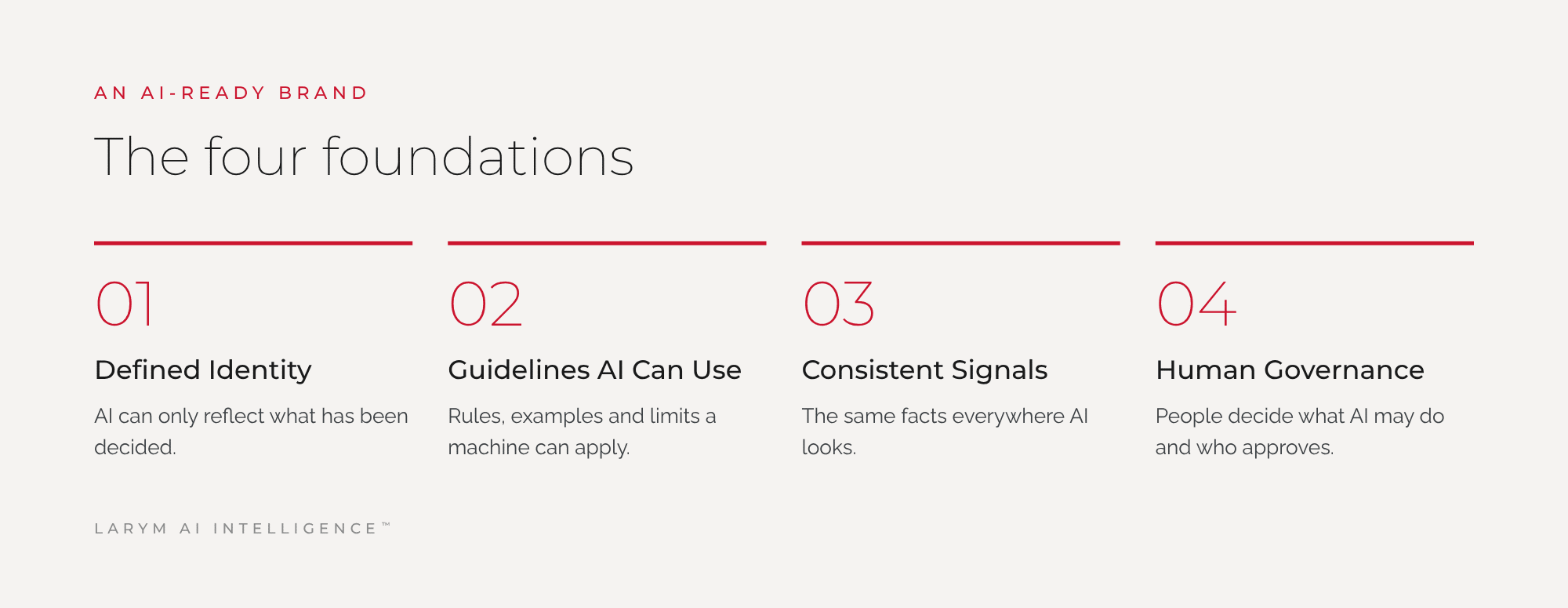
1.A Defined Identity
AI can only reflect what has been decided. That means a clear position, a clear point of view and a clear sense of what the brand is not. If your leadership team describes the company three different ways, AI will find a fourth.
2.Guidelines AI Can Use
Most brand guidelines were written for people to read and interpret. AI needs rules it can apply. An AI-ready brand documents its voice in usable form: tone, approved terms, words to avoid, and on-brand and off-brand examples. It does the same for visuals: exact color values, type styles, logo rules, and an image style described precisely enough to generate or select against.
3.Consistent Signals Everywhere
AI systems learn who you are from every place you appear. Your name, description, services and leadership should read the same on your website, your profiles, your listings and your structured data. Every conflict is a chance for AI to guess. This consistency is what builds entity authority over time.
4.Human Governance
Someone has to decide what AI may do for the brand, what it must never do and who approves the result. AI governance sets those boundaries before the tools are rolled out, and keeps decisions about meaning, positioning and public commitments with people.
From Brand Guideline to Machine Rule
Traditional guidelines assume a designer or writer will bring judgment to them. AI-ready guidelines can’t make that assumption. They have to spell out what a machine may interpret, what it must preserve and when it must defer to a person.
At Larym, we have started writing our own guidelines this way, because we are no longer writing only for people. Our voice framework has long listed words we don’t use to describe ourselves: revolutionary, game-changing, disruptive, synergy, bespoke and visionary. A writer on our team knows why those words are there. A machine only sees a list, and it will happily reach for the nearest synonym.
So we are turning that list into an instruction a machine can carry out:
Do not use “revolutionary,” “game-changing” or “disruptive” to describe Larym or its services, and do not substitute a similar superlative. State the specific capability, the demonstrated outcome or the strategic value instead. Where there is no evidence to support a claim, do not invent it.
The last sentence is the one that matters most. It takes the rule out of style preference and into brand governance. A traditional brand book tells people how a brand should look, sound and feel. An AI-ready brand system also sets the boundaries within which a machine may generate and represent it.
AI Across Design and Development
Writing is only one place AI touches a brand. Design and development are where consistency is hardest to see and easiest to lose.
Imagery and Visual Content
Generative tools can produce campaign images, illustrations and social graphics in seconds. Without a defined image style, each one drifts a little: a slightly different red, different lighting, a different mood. Over hundreds of assets, the visual identity fragments. An AI-ready brand defines its image style in words and references, and decides where generated imagery is acceptable at all.
Design Systems
A design system turns the brand into reusable parts: color tokens, type scales, spacing and components. When those parts live in the system itself, people and AI tools pull from the same source, and every new layout starts on brand.
Websites and Code
Developers increasingly use AI to write code and build pages. AI-generated code defaults to generic patterns unless it is pointed at the brand’s own components and standards. Brand consistency now depends on how a website is built and maintained as much as on how it looks at launch.
Assets and Maintenance
Logos, photography, templates and approved files multiply over time, across teams and agencies. AI can help tag, find and adapt them, but only when there is one governed library to work from. Outdated assets in circulation become outdated assets in AI output. Over years, maintenance is where brand consistency is won or lost.
How AI Interacts With Brand Guidelines
A traditional brand guide assumes a trained designer, writer or developer will read it, absorb the intent and use judgment. AI works differently. It follows what is defined, fills in what is missing and has no sense of what the brand would never say or show.
That creates three common gaps.
Missing rules
A guide that defines the logo but not the vocabulary, or the colors but not the image style, leaves AI to choose on its own.
Rules without examples
“Confident but approachable” or “warm, natural photography” means little to a tool. Clear examples of on-brand and off-brand work teach it far more.
No boundaries
Guides rarely say what the brand must never claim, promise, show or imply. AI needs those limits stated plainly.
An AI-ready guide keeps everything your team needs and adds what a machine needs: explicit rules, worked examples, stated limits and visual standards defined precisely enough to apply. Ideally, those standards also live inside your design system and website, where people and tools use them every day. For a practical checklist, see What Should Brand Guidelines Include?
Signs Your Brand Is Not Yet AI-Ready
Most organizations recognize at least one of these:
- Different teams describe the company in different ways, and no one has decided which version is right.
- AI-generated content regularly needs heavy rewriting before it sounds like you.
- Generated images and graphics don’t match your established visual style.
- New pages, templates or campaigns drift from the original design system.
- Outdated logos and assets are still in circulation.
- AI assistants describe your company inaccurately, or describe an older version of it.
- No one owns the decision about how AI may be used in brand, design and development work.
None of these is a technology problem. Each one traces back to a decision that has not been made, written down or enforced.
How to Become AI-Ready
The work follows the same order as good brand work. Decide first, document second, then scale.
1.Align leadership on the identity
Agree on how the company describes itself, what it stands for and what it will not say or show. Write it down in one place.
2.Translate the brand into usable guidelines
Add voice rules, approved terms and examples, plus exact visual standards: color values, type, logo rules and a written image style.
3.Build the brand into your systems
Turn those standards into a design system, website components and one governed asset library, so people and AI tools start from the same source.
4.Audit your signals
Compare your name, description, services, visuals and leadership across your website, profiles, listings and structured data, and fix every conflict.
5.Set governance before scaling
Decide what AI may do, what it must never do, who reviews its output and which decisions stay with people.
6.Start small and review
Pilot AI on one type of work, compare the output against the standards, and refine both before expanding.
Larym’s Perspective
At Larym, AI readiness starts where all of our brand work starts: the LARYM Framework™. Two stages matter most here.
Articulate the Identity is where we define the positioning, story and voice that AI tools will draw on. If this stage is skipped, every tool fills the gap differently. Mobilize & Maintain is where we build AI-ready systems and keep them current, because a brand that was ready last year can drift out of readiness as tools, teams and assets change.
On top of that foundation, Larym AI Intelligence™ adds the governance layer: what AI may do for your organization, what it must never do and who remains accountable. We hold ourselves to the same standard, and I write about what that has meant for Larym in How AI Systems Understand Your Brand.
The tools will keep changing. A well-defined brand gives every new tool the same thing to work from.
What This Means for Leaders
The question most leadership teams ask is which AI tools to adopt. I think the better first question is whether the brand is ready to be used by them.
AI will produce more of your brand every year, in words, images and code, and describe it to more people than your website ever will. That makes brand definition a leadership responsibility again, instead of a marketing deliverable that sits in a folder.
The organizations that benefit most from AI will not be the ones with the most tools. They will be the ones that decided, clearly and early, what their brand means and who gets to change it.
The next article in this series, What Should You Automate, and What Should Stay Human?, takes that question of authority further.
Frequently Asked Questions About AI-Ready Brands
What does it mean for a brand to be AI-ready?
It means the brand’s identity, voice and rules are defined clearly enough that AI tools can use them and AI systems can describe the brand accurately. See AI readiness.
How does AI affect brand consistency?
AI increases the volume of brand content and the number of places your brand is described. Clear guidelines keep that volume consistent, while unclear ones multiply the drift.
Can AI follow brand guidelines, including visual ones?
Yes, when the guidelines include explicit rules, examples and limits for both language and visuals. AI follows what is defined and guesses at what is not.
Do I need new brand guidelines for AI?
Usually you need to extend the ones you have. Add voice rules, visual standards precise enough to apply, worked examples and clear boundaries.
How do AI systems decide how to describe my company?
They draw on your website, profiles, listings, structured data and third-party sources. Consistent information across all of them produces a more accurate description.
How does Larym help brands become AI-ready?
We start with the LARYM Framework™ to define and align the identity, then use Larym AI Intelligence™ to set governance for how AI is used.
Do I need a full rebrand to become AI-ready?
Rarely. Most brands need clearer documentation and governance, not a new identity. We build on what you have already earned.
Can Larym audit how AI systems currently describe our company?
Yes. Our AI visibility work reviews how search engines and AI assistants describe you and fixes the inconsistencies behind any errors.
Does Larym help with design systems and websites, beyond messaging?
Yes. Through Larym Design and Larym Development, we build brand standards into design systems, websites and asset libraries, so your team and its AI tools work from the same source.
Where does an engagement with Larym usually start?
With a conversation about where AI is already showing up in your work and where your brand is least defined. From there we recommend the first step.
Related
- AI Readiness
- Brand Guidelines
- AI Governance
- What Should Brand Guidelines Include?
- What Is AI-Ready Data?
- Larym AI Intelligence™ Services
Author: Myra Peterson Love
Let's Align Your Brand

1980 Festival Plaza Dr
Suite 300
Las Vegas, NV 89135
(702) 551-1097