Part three of a three-part Larym AI Intelligence™ series on brands in the age of AI.
The Workflow That Worked Too Well
A growing company connects its CRM, project board and social scheduler. When a new client signs, an automated workflow creates the onboarding tasks, drafts the welcome email and prepares a social post announcing the partnership. It saves hours every week.
Then a new client signs who has asked to keep the relationship confidential.
The tasks are created exactly as expected and the email is ready. Unless someone designed a boundary into the workflow, the announcement may be one approval, or no approval, away from becoming public.
The technology did not suddenly become irresponsible. The organization automated a process without fully deciding where authority should stop.
This scenario is close to home for us. At Larym, discretion about who our clients are is part of the work. Some clients have asked us not to share the relationship, and in other cases we make that choice ourselves. As a trusted partner, we treat that boundary as seriously as any deliverable. An automated announcement that ignored it would do real damage to relationships built on trust, and “the AI did it” would never be an acceptable explanation, to our clients or to us.
The most important question in automation is rarely whether technology can perform the task. It is whether the organization should allow the technology to act without a person making the final decision.
What Should You Automate With AI?
A useful starting point is this:
Automate work that is repeatable, well-defined and low-risk when something goes wrong. Add human review as consequence increases. Keep decisions involving meaning, ethics, relationships, significant commitments or organizational authority with people.
In my view, the dividing line has less to do with capability than with consequence and accountability.
AI can generate, classify, summarize, organize, recommend and increasingly act through connected systems. But capability does not answer the governance question. Someone still has to decide what the system is allowed to do, and someone still has to answer for the outcome.
Why “What Can AI Do?” Is the Wrong First Question
The natural place to begin an automation conversation is capability. What can we automate? How much time can we save? What can AI do that someone on our team is doing now?
They are reasonable questions, but I don’t think they should come first. I would start here:
What authority are we comfortable giving the system?
Framed that way, the differences become clear. A system that summarizes 200 customer comments has been given one kind of authority. A system that decides which customers deserve a response has been given another. A system that drafts the response has more, and a system that sends it without review has more still.
The technology may make each step possible, but leadership decides what permission to give and where it ends.
Information, Interpretation, Meaning and Decision
One way I think about this is through four activities that are often treated as one, although each asks something different of a system and of the people around it.
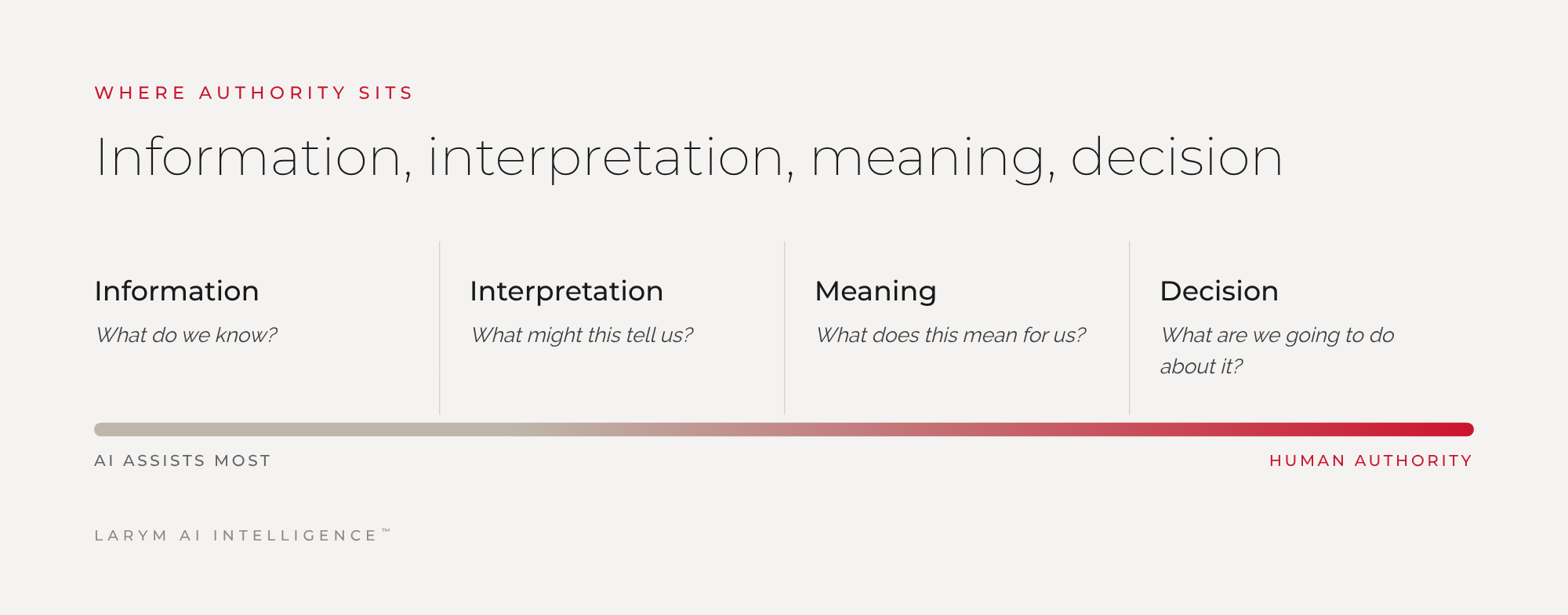
Information: What do we know?
AI can be extremely useful here. It can gather, organize, classify, compare, summarize and find patterns across large amounts of information much faster than a person could alone.
Interpretation: What might this tell us?
AI can help here too, by pointing out relationships, identifying anomalies and suggesting explanations. But interpretation begins to introduce context: history, relationships, organizational knowledge and the things that never made it into the data.
Meaning: What does this mean for us?
This is where I become much more cautious about delegation. A system can identify patterns and offer interpretations. People determine what those patterns mean within the organization’s identity, commitments, relationships and circumstances. That difference is easy to overlook, and it carries more weight than it first appears.
Decision: What are we going to do about it?
A decision creates consequence. Sometimes the consequence is trivial and easily reversed. Sometimes it affects a customer, an employee, a reputation, a financial commitment or the direction of the organization. The greater the consequence, the more important it is to know who holds the authority to decide.
This is why automation is not simply a technology architecture.
It is an authority architecture.
Three Levels of Automation
I don’t think automation should be treated as a yes-or-no decision. Most work belongs somewhere across three levels.
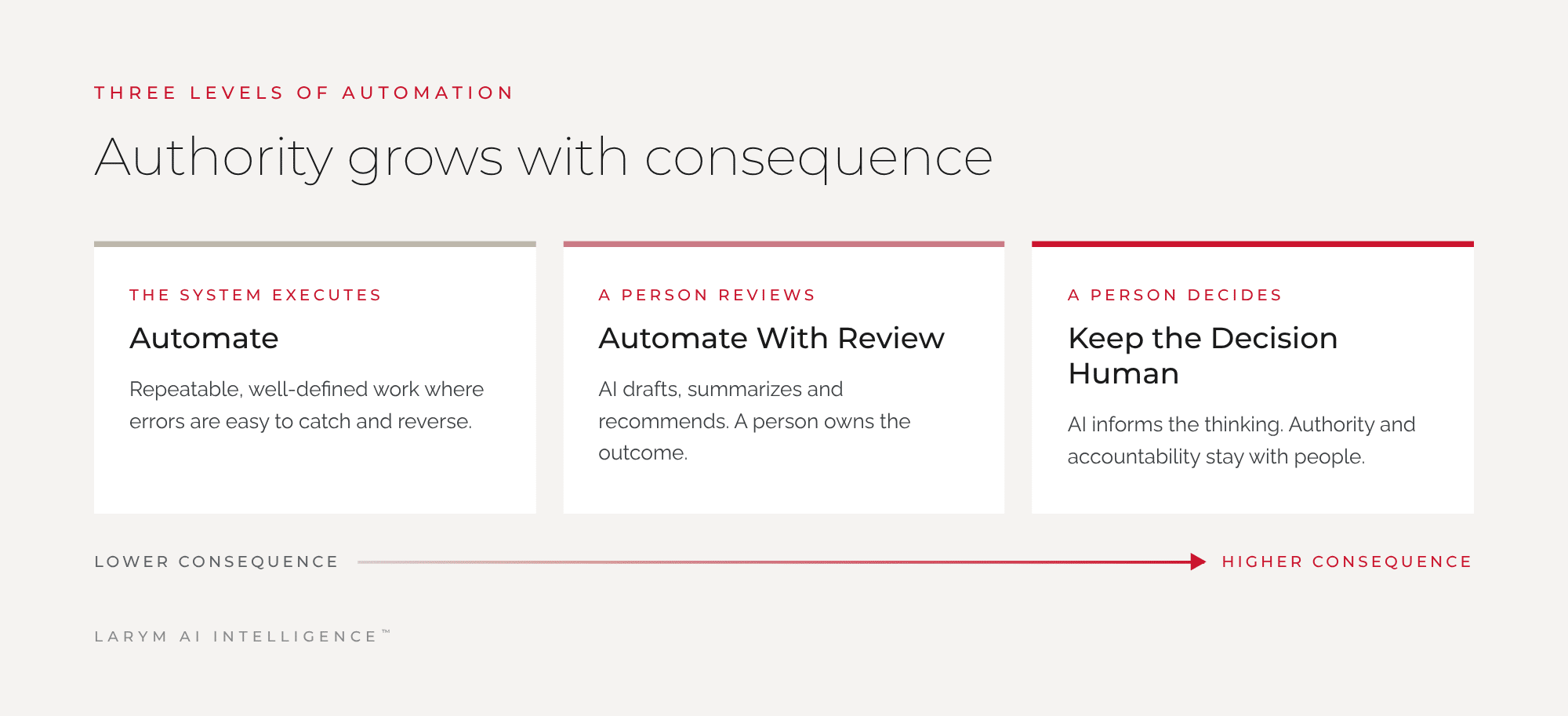
Automate
Appropriate for repeatable, well-defined work where errors are detectable and relatively easy to reverse: routing information, creating project tasks, tagging assets, syncing records between approved systems or executing previously approved actions. People set the rules, and the system carries them out.
Automate With Review
This is where AI can create significant leverage without receiving final authority. It might draft a client email, summarize performance, prepare a proposal section, generate a campaign concept or recommend an action. A person reviews the result before it becomes consequential, so the system speeds up the work while the person still owns the outcome. This is what we mean by human-in-the-loop.
Keep the Decision Human
Some work may still use AI extensively without delegating the decision itself. AI can research, organize evidence, challenge assumptions, generate alternatives and help a person think. But the decision remains with someone who has the authority and responsibility to make it.
Keeping a decision human does not mean keeping AI out of the process. It means knowing where assistance ends and accountability begins.
What Should Stay Human?
I am cautious about saying a particular task should “always” remain human, because technologies, organizations, regulations and circumstances change. But there are categories of decisions where I believe human authority should remain explicit.
Strategic judgment
Where are we going, what will we prioritize and what are we willing to give up? AI can inform strategy. It should not quietly become the source of organizational intent.
Ethical determination
What is fair, what is responsible and what are we unwilling to do even if it is efficient, profitable or technically possible? AI can raise considerations, but the organization still has to decide what it believes.
Significant public commitments
What are we promising, announcing or taking a position on publicly? AI can help prepare the language. A person with appropriate authority should own the commitment.
Authority and authorship
Who is speaking, whose judgment does this represent and whose name appears on it? AI can help someone express an idea. It should not create the appearance that a person made a judgment they never made.
That last point is especially important to us at Larym. Technology can support authority. It should not impersonate it.
Five Questions Before You Automate
Before deciding how much authority to give a workflow, I would ask five questions.
1.How difficult is the action to reverse?
Creating the wrong internal task is very different from publishing the wrong public statement. The harder something is to undo, the stronger the case for review.
2.Who will experience the consequence?
Is this an internal administrative action, or will a client receive it, an employee be affected or the public see it? Risk is not only about whether the technology makes an error. It is about who absorbs the error when it does.
3.Does the task require organizational judgment?
A rule can often be automated. An exception may require context. If the right answer depends on relationships, values, history or circumstances that can’t be fully captured in the workflow, preserve a human decision point.
4.What happens when the system is wrong?
Assume it will be at some point. No system should be governed on the assumption that it will perform perfectly. Ask what failure looks like, how it will be detected, who will know and how quickly someone can intervene.
5.Who is accountable?
This may be the most important question. If no one can say who owns the outcome, the workflow is not ready for autonomous action. Automation should make responsibility more explicit, not less.
Governance Is the Architecture Around Automation
The opening scenario is less a story about bad automation than a story about a missing decision.
Should a client relationship ever be announced without explicit permission? Once the answer is no, the workflow can be designed around that boundary. That is what AI governance does: it defines the conditions under which technology is allowed to act.
Before expanding an automated workflow, I would establish at least four things.
Scope
What is the system allowed to do, and where does its permission end?
Authority
Which decisions can the system execute, and which belong to a person?
Review
Where must a person inspect, approve, reject or modify an output before the next action occurs?
Accountability
Who owns the performance of the system and the consequences of its actions?
Governance is sometimes described as something that slows innovation down. I see it differently. Good governance gives an organization the confidence to automate more, because the boundaries have been considered before the system reaches them. For the risks of skipping this step, see What Risks Do Companies Face Without AI Governance?
Larym’s Perspective
At Larym, we do not separate automation from governance.
Larym AI Intelligence™ helps establish where AI belongs, what authority it should have, where human review remains necessary and what the organization should not delegate. Larym Development turns those decisions into working systems.
Governance without implementation stays on paper, and implementation without governance creates capability without boundaries. We bring the two together.
Our Development work follows its own interpretation of the LARYM Framework™, and for automation the most important stage is Architect. This is where governance becomes architecture: rules, permissions, approval points, exceptions and escalation paths are designed into the system rather than added after something goes wrong. Everything that follows, from testing against real exceptions to maintaining the system as tools and risks change, depends on getting that design right.
A workflow that was appropriate when it was approved may not remain appropriate forever. That is why we build intelligent automation to be maintained, not just launched.
What This Means for Leaders
Every automation decision is also a decision about authority. When a system acts, it acts because someone, somewhere, gave it permission. That permission may have been intentional, inherited from a default setting or granted gradually as people became comfortable with the technology. Either way, it exists.
Leadership’s responsibility is to make that authority visible. What can the system do? What can it recommend? What requires review? What must remain a human decision? Who owns the outcome?
The organizations that benefit most from automation will not necessarily be the ones that automate the most. They will be the ones that know why they are automating, where automation creates real leverage, and where human judgment creates value that should not be surrendered for speed.
Automate the work.
Keep the judgment.
This article closes a three-part series that began with What Is an AI-Ready Brand? and How AI Systems Understand Your Brand.
Frequently Asked Questions About AI Automation
What tasks should a business automate with AI?
Start with repeatable, well-defined work where mistakes can be detected and corrected without significant consequence. As risk, visibility or the need for judgment increases, add human review.
What should AI not be allowed to decide?
Be especially cautious about delegating strategic judgment, ethical determinations, significant public commitments and decisions involving authority or authorship. AI can support these decisions without owning them.
What does “human in the loop” mean?
Human-in-the-loop means a person remains part of the workflow at a defined point, usually to review, approve, reject, modify or take responsibility for an AI output or recommended action.
What is intelligent automation?
Intelligent automation combines automated workflows with AI capabilities such as classification, generation, analysis or decision support. The right level of human oversight depends on the task and its consequences.
How do you govern AI automation?
Define the system’s scope, authority, review requirements and accountability before expanding its ability to act, and revisit them as the workflow, organization and technology change.
How does Larym approach AI automation?
We design governance and implementation together. Larym AI Intelligence™ establishes boundaries and human authority, while Larym Development architects, builds, tests and maintains the systems.
Can Larym connect our existing tools?
Yes. Larym Development works with APIs, automation workflows, web platforms and connected business systems. The right architecture depends on your existing technology and requirements.
Will automation change how our brand shows up?
It can. Any automated system that creates, adapts, publishes or communicates brand content should operate within established brand standards and clear approval rules.
Who maintains the automation after launch?
Larym Development is built around a maintenance-first philosophy. We monitor, support, refine and evolve the systems we build, because long-term performance matters as much as launch.
Where should we start?
Choose a workflow that consumes meaningful time or creates recurring friction. Map how it works today, find where decisions occur and decide what should be automated, reviewed or kept human before selecting technology.
Related
- Human-in-the-Loop
- Intelligent Automation
- AI Governance
- How Do You Measure AI Governance?
- What Risks Do Companies Face Without AI Governance?
- Larym Development
- Larym AI Intelligence™ Services
Author: Myra Peterson Love
Let's Decide Where AI Belongs

1980 Festival Plaza Dr
Suite 300
Las Vegas, NV 89135
(702) 551-1097